Article notes
Notes, guides, and personal discoveries from things I build, enjoy, and learn.
Most review problems are not caused by malice. They are caused by ambiguity.
Comments like “this feels wrong” or “can you fix this?” force the author to guess whether the note is blocking, optional, stylistic, risky, or just exploratory. That uncertainty wastes time and quietly changes the tone of the review.
I like Conventional Comments because they solve that problem without turning review into bureaucracy.
The core idea
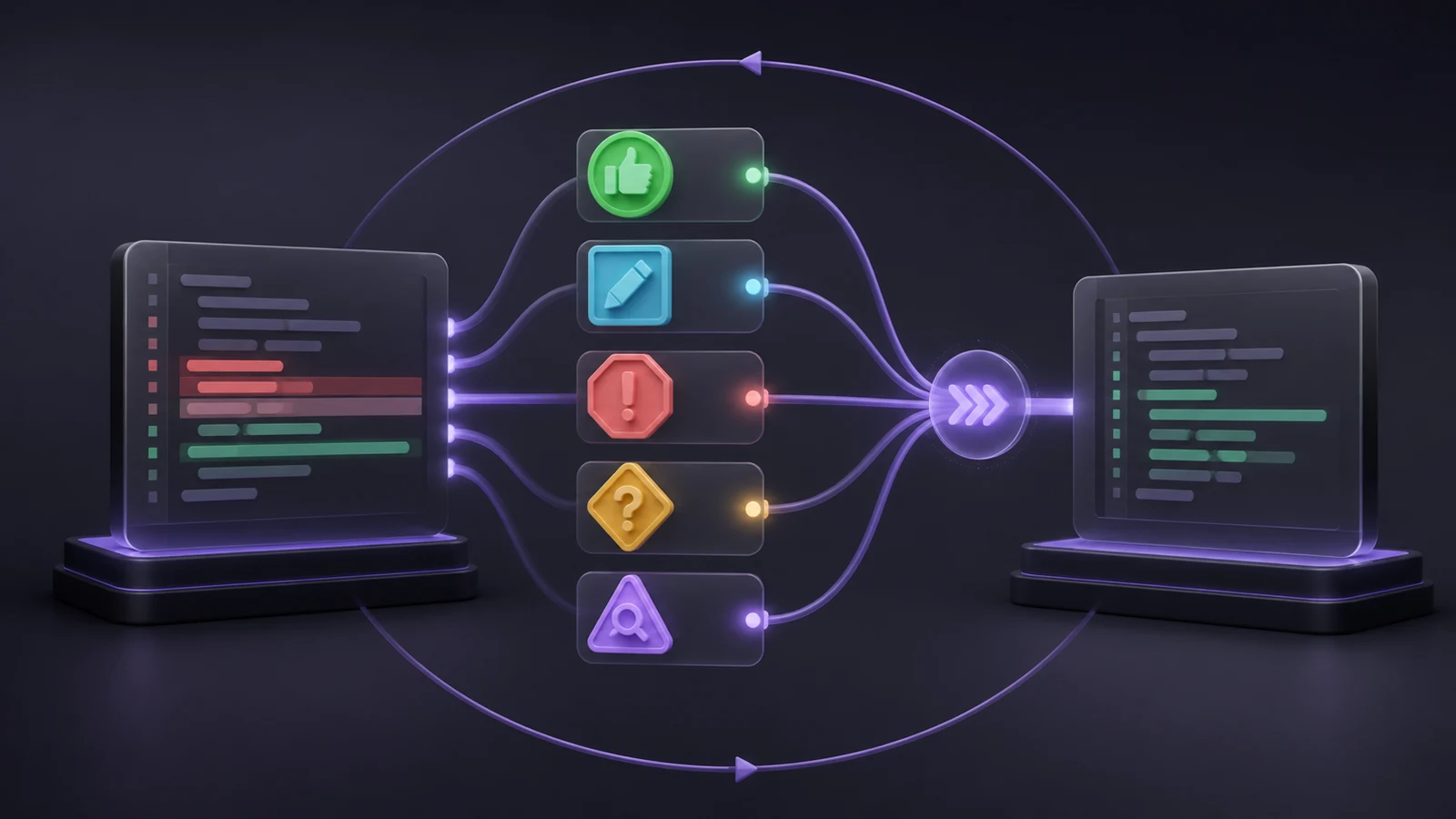
Prefix a comment with a label that explains the intent.
<label> [decorations]: <subject>

[discussion]
Examples:
suggestion: Could we move this transformation into the server action so the component stays focused on rendering?issue (blocking): This fallback skips the permission check and could expose the admin branch to non-admin users.question (non-blocking): Do we expect this request to be idempotent if the user refreshes midway through the flow?That tiny bit of structure changes the experience immediately. The author knows what kind of feedback they are reading before they parse the rest of the sentence.
Labels worth standardizing
You do not need a giant taxonomy. A small, shared set is enough:
praise:for something genuinely strongsuggestion:for an improvement with a preferred directionissue:for a real problem that needs resolutionquestion:for uncertainty or investigationtodo:for a small required tasknote:for context that should not block the work
The point is not perfection. The point is faster alignment.
Why this works so well
Conventional Comments improve three things at once.
They make comments more actionable
A labeled comment nudges the reviewer to be specific. Once I write suggestion:, I naturally feel pressure to explain the better path. Once I write issue:, I feel pressure to describe the actual risk.
They lower social friction
Ambiguous feedback often feels harsher than intended because the author has to infer whether it blocks approval. Clear intent lowers that tension.
They make review easier to scan
When a pull request has many comments, labels make it easier to triage what matters first. That helps both authors and reviewers keep momentum.
Tone still matters
Structure helps, but tone is still part of the craft.
There are a few habits I try to keep:
- Replace “you” with “we” when possible
- Explain why, not only what
- Be explicit when something is non-blocking
- Pair issues with suggestions whenever I can
- Leave real praise when the work deserves it
That last one is underrated. Praise is not fluff when it is sincere. It teaches the team what good looks like.
How I introduce this on a team
I would not roll it out as a rigid policy on day one. I would do something simpler:
- Start using the labels in my own reviews
- Explain the pattern in a short team note
- Keep the label set intentionally small
- Normalize
non-blockingdecoration for optional polish - Refine based on where confusion still shows up
It is a lightweight convention, not a ceremony.
Better reviews create better systems
Code review is one of the main ways teams transmit standards. If the review language is vague, the standards become vague too.
Conventional Comments do not make people thoughtful by themselves. But they make thoughtfulness easier to express. That is enough to improve collaboration, shorten feedback loops, and reduce the number of review threads that turn into avoidable friction.
Clear labels. Clear intent. Better conversations.
The santi020k way
A running set of principles on ownership, review quality, code clarity, responsive thinking, and releases that do not rely on heroics.
- 1Part 1Skin in the Game for Software Teams
- 2Part 2Common Code Pitfalls That Signal Maintenance Risk
- 3Part 3Avoid Magic Strings in TypeScript and JavaScript
- 4Part 4Write Better Review Feedback with Conventional Comments
- 5Part 5Git Best Practices for Calm Collaboration
- 6Part 6Responsive Design Standards That Scale Across Components
- 7Part 7Code Standards That Scale With a Team
- 8Part 8A Release Process That Reduces Drama
- 9Part 9Avoid Inverted Conditionals When Clarity Matters
- 10Part 10AI Coding Is Probabilistic. Your Delivery Process Should Not Be.
- 11Part 11Muted Commands Make AI Automation Faster and Cheaper
- 12Part 12Why Developer Experience Work Should Be Measured Like Product Work
- 13Part 13What Changed When I Started Writing Architecture Notes Every Month
- 14Part 14How I Built the santi020k Developer Tool Ecosystem
Comments
Powered by GitHub Discussions — sign in with GitHub to join the conversation, orreply on GitHub.